
Kinetico Water

China Top 10 Manual Ceramic Coffee Grinder Manufacturers

Manual coffee preparation is gaining visibility as drinkers seek control over grind size, freshness, and brewing pace. The National Coffee Association’s 2024 National Coffee Data Trends report found that 67% of U.S. adults drank coffee in the past day. The International Coffee Organization estimated global consumption at 177 million 60-kilogram bags in 2022/23. These figures describe coffee drinking, not grinder sales. That distinction matters.

A Manual Ceramic Coffee Grinder offers a compact, electricity-free way to grind beans, often using ceramic burrs designed to resist corrosion and limit heat buildup. But results depend on more than burr material. Adjustment range, axle stability, handle comfort, and consistency across grind settings all shape the cup. A grinder that feels smooth in a product photo may behave differently with dense beans and a full hopper.

This guide introduces ten manufacturers in China and the factors buyers can use to compare them. We focus on verifiable product details, manufacturing capabilities, quality controls, and available customization—not unsupported claims about “perfect” extraction. Specifications and certifications should be checked directly with each supplier, since models and production standards can change. Small details count. A loose adjustment ring or uneven burr alignment may become obvious after several turns. The comparison is useful, but it cannot replace sample testing. Some information may also be difficult to confirm publicly, so buyers should ask clear questions before making a decision.
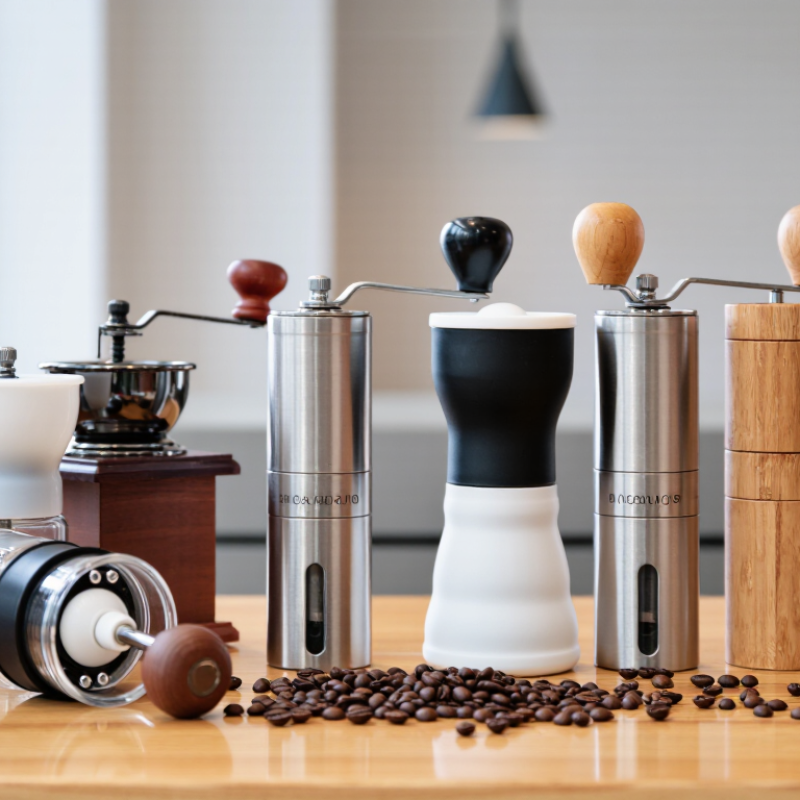
China Top 10 Manual Ceramic Coffee Grinder Manufacturers

Manual Ceramic Coffee Grinders: Design, Materials, and Core Components

A manual ceramic coffee grinder is a small system of parts, not just a pair of burrs. Its body holds the beans, while a crank turns an inner burr against a fixed outer burr. Ceramic burrs resist corrosion and can stay sharp through regular use, but they are brittle if dropped on a hard floor. A clean cut matters. Burr alignment affects particle consistency, so a loose shaft may produce uneven grounds even when the ceramic looks intact. The adjustment mechanism sets the gap between burrs; smaller gaps generally suit finer brewing, though results also depend on bean type and grinding speed.

Materials shape both feel and upkeep. Stainless steel shafts resist rust, while wood or molded polymer bodies can reduce weight and improve grip. A clear glass catch cup makes grind size easy to inspect, but it needs careful handling. The crank should turn smoothly without wobbling, and its handle should feel comfortable during a full dose. Check that adjustment parts stay secure and that grounds do not collect around the burr carrier. These details are easy to overlook. A ceramic mechanism may seem low-maintenance, but it still benefits from dry brushing and occasional inspection. Durability is not only about the burr material; fit, assembly, and careful use count too.

China’s Manual Ceramic Coffee Grinder Manufacturing Landscape

China’s manual ceramic coffee grinder sector is best understood as a varied supply network, not a single production model. Factories may handle metal housings and assembly in-house, while ceramic burrs or plastic components come from specialist suppliers. This arrangement can shorten development time, but it makes supplier coordination important. Details matter.

For buyers, the key checks are burr alignment, handle stability, adjustment consistency, and the feel of the grinding mechanism. Ceramic burrs should be checked for chips, uneven edges, and secure seating after assembly. Ask for repeatable sample tests using the same beans and grind setting; a smooth first turn proves little. Factories with clear inspection records can explain how they check dimensions and manage defects. Records vary.

The landscape includes manufacturers offering export-ready packaging and custom colors, alongside smaller workshops suited to modest runs. Confirm capacity, lead times, and tooling ownership in writing, since these can differ between samples and production orders. The picture is not perfectly uniform. A practical assessment includes a pre-production sample, a written tolerance sheet, and a review of the first batch. Even then, small differences may remain, and that deserves attention rather than a polished claim.

China Top 10 Manual Ceramic Coffee Grinder Manufacturers - China’s Manual Ceramic Coffee Grinder Manufacturing Landscape

A non-branded overview of ten manufacturing and product dimensions. It does not rank or identify individual companies; company-specific production figures and certifications should be verified directly with suppliers.

No. Manufacturing dimension Industry context What buyers should verify
1 Burr material Ceramic burrs are commonly made from alumina-based ceramic. Ceramic burrs are corrosion-resistant, but performance depends on design, material grade and manufacturing quality. Request the ceramic specification, burr drawings and sample grind results; do not rely on “ceramic” alone as a quality grade.
2 Burr geometry Manual grinders commonly use conical burr assemblies. Burr shape and tooth geometry affect particle distribution and grinding effort. Check burr dimensions, alignment, fit and grind consistency using the intended coffee and brewing method.
3 Grind adjustment Adjustment systems may use stepped settings or continuous adjustment. The number of usable settings and repeatability vary by design. Ask for adjustment diagrams, setting repeatability and test results across espresso, pour-over and French press ranges, where applicable.
4 Body and handle materials Product designs may combine metal, plastic, wood or other materials. Material choice affects weight, durability, appearance and cost. Confirm material grades, surface finishes, component sourcing and the specification of every part in the approved sample.
5 Shaft and bearing assembly Shaft support and burr alignment influence operating stability. Assembly design differs among grinder models. Inspect shaft play, burr wobble, handle attachment and grinding feel on production-representative samples.
6 Hopper and grounds capacity Capacity is model-specific and depends on the hopper and grounds container design; there is no single standard capacity for manual grinders. Measure usable capacity in grams on the final sample and confirm dimensions, tolerances and any stated capacity claims.
7 Production processes Depending on the design, production can involve ceramic forming and firing, metal machining or forming, plastic molding, finishing and final assembly. Clarify which processes are performed in-house, which are subcontracted and how process changes are controlled.
8 Quality control Relevant checks can include burr dimensions, assembly fit, adjustment function, visual defects and grinding performance. Inspection plans vary by supplier. Request the inspection plan, defect criteria, batch traceability method and recent, model-specific quality records.
9 Customization and packaging Customization may involve colors, finishes, packaging and product configuration. Available options and minimum order quantities are supplier- and model-specific. Confirm tooling charges, minimum order quantity, artwork approval, packaging tests and lead times in writing.
10 Food-contact and market compliance Applicable food-contact requirements depend on the materials, destination market and product claims. Requirements should not be assumed to be identical across markets. Identify the destination market and request relevant, current test reports and declarations for the specific product and materials.

Criteria for Evaluating Chinese Grinder Manufacturers

Evaluating Chinese manual ceramic coffee grinder manufacturers requires more than checking burr material or a polished sample. The International Coffee Organization estimated global coffee consumption at 177 million 60-kilogram bags in 2023/24, underscoring the scale of the market, but this figure does not measure grinder demand. Treat it as context, not proof of a supplier’s quality. Ask for ceramic composition records, burr-dimension tolerances, and inspection results from multiple production batches. Then test grind consistency, handle wobble, adjustment repeatability, and grounds retention using the same beans and settings. Small differences matter.

Review factory controls, traceability, food-contact documentation, packaging tests, and written defect procedures. Request sample units from regular production, not only hand-selected prototypes. ISO 9001 documentation can indicate a quality-management system; it does not guarantee uniform grinder performance. A useful test log records grind setting, time, particle distribution, and user effort. Repeat tests with different operators. Results can vary, and that is worth noting rather than hiding.

Tips: Ask for spare-burr availability and realistic lead times. Check whether replacement parts fit across batches. A sample may feel smooth yet reveal alignment issues after repeated use, so test it over several weeks. One limitation: a small sample cannot establish long-term durability. Ask how the manufacturer tracks field failures and updates designs.

China’s Manual Ceramic Coffee Grinder Manufacturers: Evaluation Criteria

Suggested weighting for comparing manufacturers—not measured scores or a ranking of individual companies.

The 100% total represents a sample evaluation model. Prioritize grind consistency, burr durability, and adjustment range, then verify each manufacturer’s specifications, quality controls, replacement-part availability, and support.

Profiles of Ten Leading Manual Ceramic Coffee Grinder Manufacturers

Profiles of Ten Leading Manual Ceramic Coffee Grinder Manufacturers

These ten profiles examine manufacturers through their production strengths, rather than relying on promotional claims. One may specialize in ceramic burr shaping, where even tooth spacing supports steadier grinding. Another may focus on alumina material consistency. Small details matter. A third profile considers spindle alignment, since a slight wobble can create uneven grounds. A fourth looks at adjustment mechanisms, including how clearly users can feel each setting.

Other manufacturers may stand out for durable housings, comfortable crank handles, or compact designs suited to travel. Assembly practices also deserve attention. A careful maker checks burr fit and handle movement before packing each unit. Some suppliers offer custom colors or private-label production, while others concentrate on reliable standard models. These differences affect sourcing decisions, but they should be verified with samples and factory documentation.

A useful comparison also asks how manufacturers respond to wear, replacement-part requests, and practical user feedback. Ceramic burrs resist corrosion, yet they can chip if mishandled. That caveat matters. Buyers should examine grinding tests, inspect parts under normal use, and ask how quality checks are recorded. A polished product photo cannot show burr alignment or long-term adjustment stability. These profiles therefore emphasize measurable details, while acknowledging that factory claims still need independent checking.

Comparing Manufacturers by Product Range, Quality, and Sourcing Capabilities

A practical comparison of ten Chinese manual ceramic coffee grinder manufacturers should begin with product range, not catalog size alone. Check whether each supplier offers different burr shapes, adjustment steps, hopper capacities, and replacement parts. A grinder for travel should feel different from one designed for a kitchen counter. Ask for dimensions and sample units. Small details matter.

Quality is easier to judge when specifications are concrete. Inspect ceramic burr alignment, handle wobble, adjustment consistency, and how grounds collect after repeated use. A smooth finish can hide uneven grinding. Test it. Request material descriptions, inspection records, and clear tolerances rather than relying on broad claims. Samples from one production run may not represent every batch, so ask how consistency is monitored.

Sourcing capability includes more than the quoted unit price. Compare minimum order quantities, lead times, packaging options, customization limits, and how quickly the supplier answers technical questions. Confirm which parts can be replenished and whether product specifications are documented. A broad catalog is useful, but it can also make comparisons messy. No ranking is perfectly clean. I would give more weight to repeatable sample performance and direct answers than to polished sales language; that judgment may change after a factory audit.