China Top 10 Flexible LED Work Light Manufacturers
Flexible Led Work Light products bring illumination into tight, demanding spaces: beneath a vehicle chassis, inside a cabinet, or across a dim workshop bench. Their flexible necks, magnetic bases, and rechargeable batteries can improve positioning and reduce reliance on fixed lighting. Yet flexibility alone does not prove quality. Buyers also need dependable brightness, practical runtime, sturdy construction, and clear safety information.
Energy performance matters, too. The U.S. Department of Energy reports that LED lighting uses at least 75% less energy and can last up to 25 times longer than incandescent lighting. These figures describe LED lighting broadly, not every portable work light. That distinction matters. A product’s real usefulness depends on its optics, battery, heat management, and working conditions. A bright specification sheet cannot replace measured runtime.
This guide examines ten Chinese manufacturers through product range, manufacturing capability, customization options, and the clarity of available technical documentation. Useful checks include lumen output, battery capacity, charging time, ingress protection ratings, warranty terms, and evidence supporting durability claims. Look closely at how a lamp holds its position after repeated bending. Small details matter. Public specifications can be incomplete, and supplier rankings are not certifications. No shortlist is perfect. Treat it as a starting point, then confirm samples, test reports, and after-sales support directly with each manufacturer.
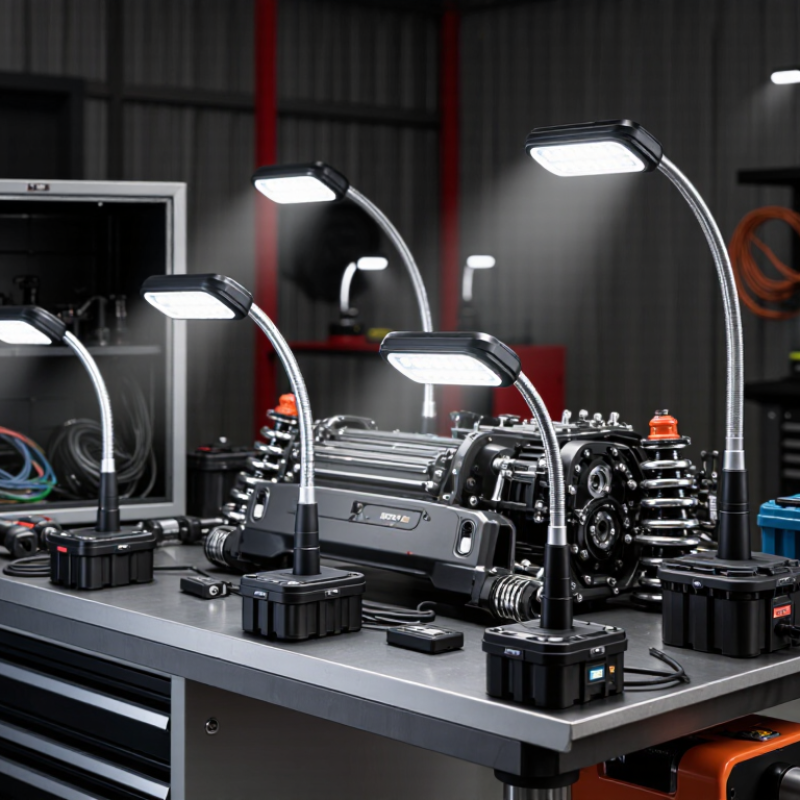
Flexible LED Work Lights: Definition, Design, and Industrial Uses
Flexible LED Work Lights: Definition, Design, and Industrial Uses
A flexible LED work light combines an energy-efficient light source with a bendable neck, adjustable head, or repositionable mounting system. Workers can direct its beam into a machine housing, beneath a vehicle, or across a crowded workbench. Common designs use impact-resistant housings, sealed switches, and magnetic or clamp bases. The best choice depends on the task, not simply brightness.
Design details matter. A narrow beam can reveal a fastener inside a cabinet, while a wider beam helps illuminate a repair area evenly. Adjustable color temperature and dimming can reduce glare during close inspection. The U.S. Department of Energy reports that LEDs use at least 75% less energy and can last up to 25 times longer than incandescent lighting. These figures describe LED lighting generally, not every work-light model. Still, flexibility is not magic. Poor balance or a weak joint can let the lamp drift out of position.
Tips: Check the light’s runtime, mounting stability, beam pattern, and ingress-protection rating before purchase. In dusty workshops, inspect seals and switches regularly. A bright lamp that cannot stay aimed is frustrating.
Performance Metrics: Lumens, lm/W, CRI, and Color Temperature
When comparing flexible LED work lights, judge measured lumens, not LED-chip claims. The U.S. Department of Energy’s 2022 Solid-State Lighting R&D Opportunities report notes leading LED packages exceeding 200 lm/W. That is package performance, not a guarantee for a complete lamp: drivers, diffusers, and heat reduce delivered output. Ask suppliers for luminaire test results under IES LM-79, including total lumens and efficacy. A bright-looking beam can still leave dark corners.
For color quality, CRI 80 is a practical minimum for general repair work; choose CRI 90 or higher when distinguishing wire colors or surface defects matters. CIE’s TM-30 method adds fidelity and gamut measures, offering more detail than CRI alone. A 4000K–5000K color temperature often gives a neutral workbench appearance, but preference varies. Check the stated value against a measured report. Specifications are not always consistent.
Tips: Compare lm/W only between products tested in similar modes. Check output at full power and after the light warms up; heat can reduce brightness. A tidy spec sheet is useful, not proof.
Protection Ratings: IEC 60529 IP65 vs. IP67 for Worksite Use
For flexible LED work lights, the IP rating can matter as much as brightness on a damp, dusty worksite. Under IEC 60529, the first digit 6 means dust-tight protection. The second digit describes water resistance: 5 covers water jets, while 7 covers temporary immersion under specified test conditions, commonly up to one metre for 30 minutes.
These ratings are not interchangeable. An IP67 light is not automatically tested for IPX5 water jets unless both ratings are stated. That detail matters when a light is hosed down or exposed to forceful splashes. Check the rating for the complete assembly, including connectors and cable entries. A well-sealed lamp head is less reassuring if its plug is exposed. Flexible sections and repeated bending can also stress seals over time. Ratings describe test conditions, not every real worksite mishap.
Tips: Match the rating to the cleaning method. Inspect seals and connectors for cracks, and follow the maker’s care instructions. If the label only says IP67, do not assume it is suitable for high-pressure rinsing. Small details are easy to miss.
China’s Top 10 Manufacturers: Products, Customization, and Markets
China’s flexible LED work light manufacturers serve repair shops, vehicle technicians, construction crews, and industrial maintenance teams. Comparing ten suppliers is more useful when you examine product design, customization, and target markets—not just brightness claims. Small details matter. Check how the flexible neck holds its angle, whether the magnetic base grips a painted steel panel, and how easily workers can replace or recharge the battery.
Product ranges may include slim inspection lamps, foldable work lights, and hands-free models with hooks or clips. Custom options can cover color temperature, beam spread, battery capacity, housing material, packaging, and logo placement. Ask for sample units and clear specifications before ordering. A photograph cannot show whether a hinge loosens after repeated adjustments. Some details are easy to miss, even during a careful review. Manufacturers may serve domestic distributors, export wholesalers, or private-label buyers, so confirm production capacity and communication processes for your order size.
Tips: Test a sample in a dim workshop, not only under showroom lighting. Compare runtime at the brightness setting workers will actually use. Request written details on charging time, warranty coverage, and inspection procedures. If a supplier cannot explain a specification clearly, pause and ask again.
Supplier Evaluation: IEC 60598-1, Testing, Certifications, and Warranty
When comparing China’s top 10 flexible LED work light manufacturers, treat IEC 60598-1 as a baseline, not a complete quality verdict. Ask for test reports tied to the exact model, including its cable, power supply, and adjustable joints. A report for a similar-looking lamp may not cover the product you will receive.
Look for documented checks on insulation, electric strength, temperature rise, and mechanical stability. For flexible lights, inspect hinge movement, cable strain relief, and how the housing handles repeated repositioning. Ask who performed the tests, which standard edition was used, and whether the laboratory’s scope covers the relevant work. Confirm that certificates identify the model and manufacturer clearly. Paperwork matters. So does a sample inspection.
Warranty terms reveal how a supplier handles real failures. Request the coverage period, exclusions, replacement process, and availability of service parts in writing. Clarify whether damage to a joint or cable is covered, since these areas may wear sooner under frequent movement. Even a careful review can miss production differences between samples and bulk orders. I would still request pre-shipment checks and keep records of agreed specifications. That extra step is not perfect, but it makes later disputes easier to assess.

