

A well-chosen Bubble Pendant Lamp does more than soften a room. It shapes how a dining table, hotel lobby, or kitchen island feels after dark. For buyers, the challenge is separating attractive product photography from dependable manufacturing. Glass thickness, bubble placement, metal finishes, wiring access, and packaging all matter. Small details become costly when an order arrives damaged or inconsistent.
Energy performance also deserves attention. The International Energy Agency reports that lighting accounts for about 15% of global electricity use and around 5% of greenhouse gas emissions. The U.S. Department of Energy’s Energy Saver guidance says LED bulbs use at least 75% less energy than incandescent bulbs. These figures do not describe every pendant fixture. They do show why buyers should check compatible light sources, wattage, dimming options, and replacement access before choosing a supplier.
This guide introduces ten Chinese manufacturers for buyers comparing design, production capability, customization, and export experience. A useful supplier review goes beyond catalog images. Ask for material specifications, finish samples, test documentation, lead times, and clear answers about quality checks. Look closely. A photograph cannot prove consistency across a full shipment. The ranking is a starting point, not a substitute for factory due diligence; supplier capabilities can change, and buyers should verify current details directly. A little caution is worthwhile.
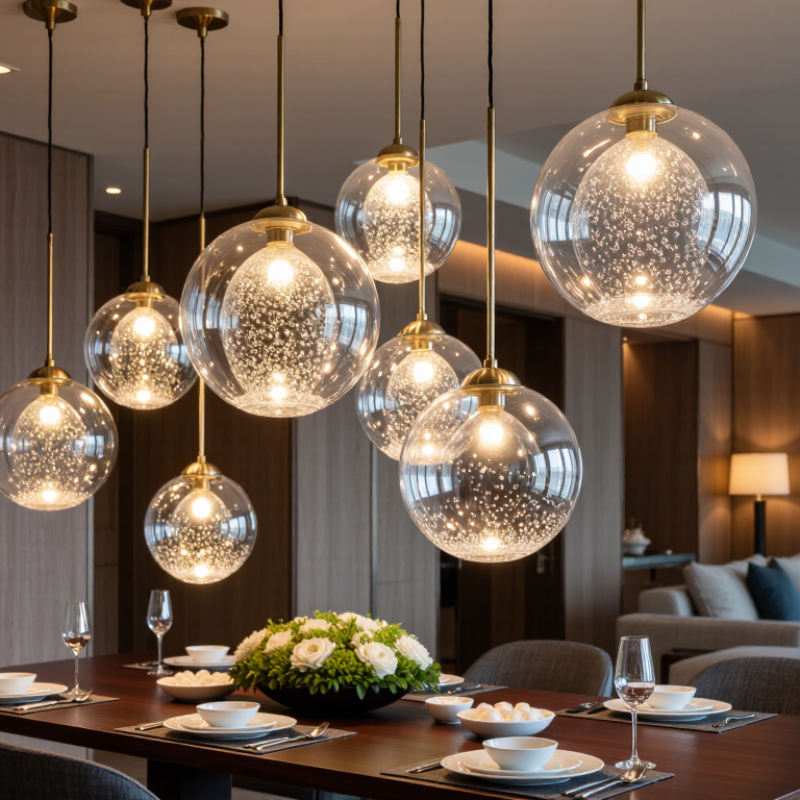
Bubble pendant lamps rely on the glass as much as the light source. Clear soda-lime glass gives a crisp, exposed-bulb look, while opal glass softens glare over a dining table. Borosilicate glass suits designs needing better resistance to heat changes, though buyers should confirm the maker’s tested limits. Smoked or seeded finishes add texture, but they can reduce perceived brightness. Small details matter. Check globe diameter, glass thickness, opening size, and suspension length against the room and ceiling height.
LED choices shape comfort and running costs. The U.S. Department of Energy’s Energy Saver guidance says LEDs use at least 75% less energy and last up to 25 times longer than incandescent lighting. Ask for lumens, watts, color temperature, color-rendering index, dimming compatibility, and the replaceable-light-source details. For comparison, request photometric results measured under ANSI/IES LM-79-19, which covers electrical and light-output testing for solid-state products. A 2700–3000 K option often feels warm; 4000 K appears cooler. Not always. Glass tint and room finishes shift the impression, so sample photographs cannot replace a lit sample. Check the canopy diameter, cord adjustment, driver location, and stated voltage before ordering.
Indicative buyer comparison of common bubble pendant lamp configurations. Specifications vary by supplier and should be confirmed before ordering.
| No. | Pendant Configuration | Glass Type & Finish | Typical Dimensions | LED Option | Typical Power | Color Temperature | Supply & Dimming | Typical Applications |
|---|---|---|---|---|---|---|---|---|
| 1 | Single clear globe | Blown soda-lime glass; clear | Ø 150–200 mm; drop 300–1500 mm | Replaceable LED bulb, E27/E26 | 4–8 W | 2700–4000 K | 220–240 V or 110–120 V; dimmable with compatible bulb and control | Kitchen islands, bedside lighting, small dining areas |
| 2 | Oversized single globe | Blown soda-lime glass; clear or light smoke | Ø 250–350 mm; drop 400–2000 mm | E27/E26 LED bulb or integrated LED module | 6–15 W | 2700–4000 K | Regional mains voltage; dimming depends on the LED and driver | Entryways, living rooms, restaurant focal points |
| 3 | Opal globe pendant | Opal / acid-etched glass; white diffusing finish | Ø 180–300 mm; drop 300–1800 mm | Integrated LED or replaceable LED bulb | 8–18 W | 2700–4000 K | Regional mains voltage; optional dimmable driver | Bedrooms, hospitality interiors, soft ambient lighting |
| 4 | Ribbed bubble globe | Moulded glass; clear or frosted ribbed surface | Ø 180–280 mm; drop 300–1500 mm | E27/E26 LED bulb | 5–10 W | 2700–4000 K | Regional mains voltage; compatible dimmable bulb required | Cafés, dining rooms, decorative residential lighting |
| 5 | Tinted globe pendant | Blown glass; amber, smoke, or light grey tint | Ø 160–300 mm; drop 300–1800 mm | E27/E26 LED bulb; filament-style LED commonly used | 4–10 W | 2200–3000 K commonly specified | Regional mains voltage; dimming depends on bulb and dimmer compatibility | Bars, lounges, dining spaces, warm accent lighting |
| 6 | Cluster of three globes | Blown clear, opal, or mixed-finish glass globes | Globes Ø 120–200 mm; canopy Ø 250–350 mm | Three replaceable LED bulbs, E27/E26 or E14/E12 by design | 12–24 W total | 2700–4000 K | Regional mains voltage; dimmable when all bulbs and control are compatible | Kitchen islands, stairwells, reception counters |
| 7 | Linear multi-globe pendant | Clear or opal glass on a linear metal canopy | Overall length 900–1500 mm; globes Ø 120–200 mm | Integrated LED modules or replaceable LED bulbs | 18–45 W total | 3000–4000 K commonly specified | Regional mains voltage; optional dimmable driver or compatible bulbs | Dining tables, long islands, conference tables |
| 8 | Integrated LED bubble pendant | Clear or opal glass with concealed LED source | Ø 150–300 mm; drop 300–1800 mm | Integrated LED and constant-current driver | 6–20 W | 2700 K, 3000 K, or 4000 K options | Driver matched to regional mains voltage; dimming method must be specified | Modern residential and commercial interiors |
| 9 | Large multi-light cluster | Mixed-size clear, opal, or tinted glass globes | 5–12 globes; overall spread typically 600–1200 mm | Replaceable LED bulbs or integrated LED modules | 30–100 W total, depending on light count | 2700–4000 K, specified consistently across sources | Regional mains voltage; confirm circuit load and dimming arrangement | Double-height spaces, hotel lobbies, large staircases |
| 10 | Custom-height cluster pendant | Blown glass; finish and globe sizes selected to order | Typically 3–10 globes; suspension length made to project requirements | LED bulbs or integrated LED; confirm replacement and servicing access | Project-dependent; specify total load before production | 2700–4000 K, based on project needs | Confirm voltage, driver, dimming protocol, and applicable certification for destination market | Custom residential, hospitality, and contract projects |
Buyer checks: request glass dimensions and weight, LED lumen output, color-rendering index (CRI), driver details, suspension and canopy dimensions, installation instructions, and destination-market safety documentation. Confirm whether bulbs or LED modules are included.