

A car’s cabin is small, so the right Car Aroma Diffuser should feel subtle, steady, and easy to manage. But “best” depends on your vehicle, scent preference, and tolerance for maintenance. A vent-clip diffuser sits near the airflow and is simple to install. A waterless nebulizing model can offer stronger fragrance, though its output may feel intense in a compact car. Passive wooden or felt diffusers need no power, but their scent can fade quickly. Small details matter: a warm dashboard, a closed window, or a long commute can change how fragrance feels.
Sensory psychologist Rachel Herz’s research explores how smell connects with emotion and memory. Applying that insight to car use, this guide follows a practical principle: “A good cabin scent should support the drive, not compete with it.” That is a testing principle, not a direct quotation from Herz. We compare diffuser types by scent control, upkeep, portability, and how evenly they fragrance a cabin. We also note where evidence is limited: personal sensitivity varies, and a scent that feels gentle to one passenger may distract another. Start lightly. Check the intensity after a short drive. The best choice is not always the strongest or most expensive; it is the one that remains comfortable on an ordinary trip.
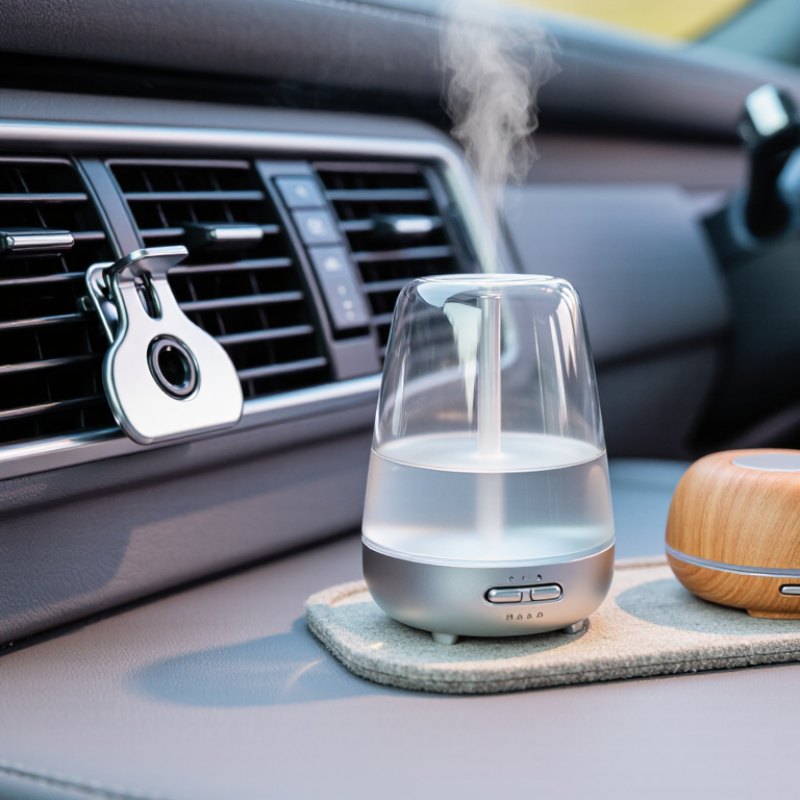
A car aroma diffuser works by moving fragrance molecules from a scented material into cabin air. In a passive model, liquid or a porous pad evaporates naturally. A vent-mounted fan speeds that process by pushing air across the scented surface. Heat can increase evaporation, while an ultrasonic device uses vibration to disperse tiny droplets. These methods feel similar, but they release fragrance differently.
The mechanism affects how quickly scent spreads and fades. A vent fan may give a stronger burst when the blower runs, then little scent when it stops. Passive pads are quieter, though their output can be uneven. Ultrasonic units add moisture with fragrance droplets, so placement and cleaning matter. Small details count.
Air quality deserves attention, too. The U.S. Environmental Protection Agency reports that indoor VOC levels are often two to five times higher than outdoor levels, and may exceed ten times during some activities. Those figures describe indoor environments generally, not car cabins. Still, they explain why fragrance strength is not the only measure of performance. A closed vehicle has limited air volume, so use a low setting and allow fresh air in when practical. Fragrance can also mask an unpleasant odor rather than remove its source. That distinction is easy to overlook.