Why Choose a Horizontal Ribbon Mixer?
Choosing the right mixer affects product consistency, production time, and daily cleaning. A Horizontal Ribbon Mixer is designed to move materials through a horizontal trough using inner and outer helical ribbons. Their opposing motion helps carry ingredients along the vessel while blending them across its width. For dry powders and granules, this action can create a practical balance between mixing performance and straightforward operation. The result depends on more than the machine itself.
Operators should consider batch size, ingredient properties, and the required blend uniformity before selecting a model. Fine powders may behave differently from coarse granules, especially when density or moisture varies. Small details matter. Ribbon clearance, rotation speed, fill level, and discharge design can all influence results. Ask the manufacturer for relevant test data, and confirm that the proposed configuration suits the actual process. A trial batch can reveal issues that a specification sheet may not.
The design also offers useful access for inspection and routine maintenance, though cleaning needs depend on the product and mixer construction. Some applications require additional attention to dust control or material residues. No single mixer fits every plant. Even a well-sized unit can disappoint when loading, operating, or cleaning practices are overlooked. Comparing a Horizontal Ribbon Mixer with other mixing options helps clarify its strengths and limits. The best choice is the one that meets measurable process needs, not simply the one with the largest capacity or most attractive brochure.
What Is a Horizontal Ribbon Mixer?
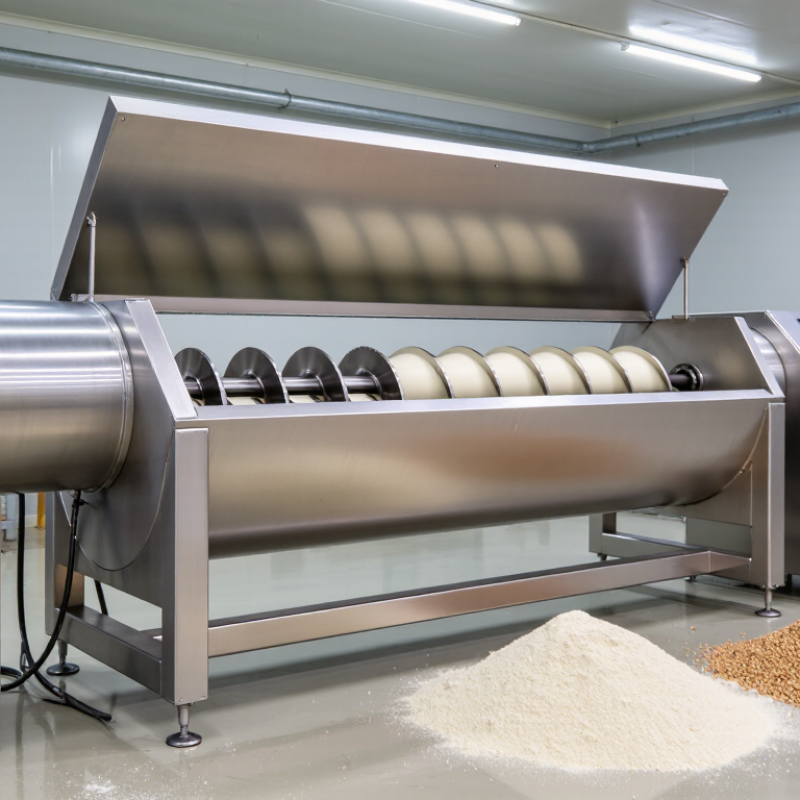
A horizontal ribbon mixer is a batch machine with a U-shaped trough and a rotating shaft. Inner and outer helical blades, called ribbons, move material in opposing directions. This creates circulation along the trough and folds material through the bed. In many designs, powder moves from the ends toward the center, then returns along the trough. The action helps distribute ingredients through a broad volume. Not instantly, though.
Common uses include blending dry powders and granules in food, chemical, and building-material production. Performance depends on particle size, density, moisture, fill level, and mixing time. A light powder and a heavy granule may separate again after mixing. That detail is easy to overlook. The machine is not ideal for every recipe; cohesive or heat-sensitive materials may need trials and process checks. A bottom discharge valve releases the batch, while cleanout access matters between runs.
Tips: Start with a moderate fill and a short test cycle. Check samples from several points, not just near the outlet. Record the settings. Increase mixing time only if testing shows unevenness; longer mixing can sometimes worsen separation.
How Does Its Mixing Mechanism Work?
A horizontal ribbon mixer uses a U-shaped trough and a rotating shaft fitted with inner and outer helical blades. The outer ribbon moves powder toward one end, while the inner ribbon carries it back. This creates opposing axial flows. Material also rolls and folds across the trough, helping ingredients meet throughout the batch.
Watch the movement. A ribbon lifts a small wave of powder, then releases it into neighboring material. Repeated circulation can distribute minor ingredients, such as a measured colorant in a dry blend. The process is not simply “faster is better.” Shaft speed, fill level, particle size, and moisture all affect how evenly the batch mixes. Too much material may restrict circulation; too little may leave parts of the ribbons underused. Some powders also cling to the trough or separate after mixing. That can be easy to overlook. In practice, operators check samples from different locations and adjust mixing time based on results, rather than assuming a fixed cycle will suit every recipe.
Which Materials and Processes Can It Handle?
A horizontal ribbon mixer can blend free-flowing powders, granules, and some lightly damp materials. Common examples include flour, powdered minerals, dry food ingredients, and pharmaceutical excipients. Its inner and outer ribbons move material along the trough and back through the batch. This helps combine ingredients with different particle sizes or densities. Results still depend on formulation and operating conditions.
The mixer suits dry blending, premix preparation, and controlled liquid addition when fitted with a suitable spray system. A fine liquid mist can coat particles more evenly than pouring from one spot. But sticky pastes and highly wet slurries may cling to the ribbons or trough. Fragile particles can also break during mixing. Not every material behaves as expected; a small trial can reveal problems early. Discharge and cleaning requirements matter, too.
Tips: Match the batch size to the mixer’s working capacity. Take samples from several points, not just the outlet. Check whether added liquid leaves damp clumps. These details can expose uneven mixing before production scales up.
What Benefits Does a Horizontal Ribbon Mixer Offer?
A horizontal ribbon mixer offers controlled, repeatable blending for powders and small quantities of liquid. Its inner and outer ribbons move material in opposite directions, carrying ingredients across the trough rather than relying on one central flow. That helps distribute minor ingredients through a larger batch. In practice, results still depend on fill level, mixing time, particle size, and loading sequence. A good machine cannot correct every poor process choice.
Energy use is worth checking, too. The International Energy Agency’s Energy Efficiency 2023 report puts industry at about 37% of global final energy consumption. That figure covers many industries, not mixers alone, but it gives context for measuring motor load and batch time. For food producers, the FAO’s 2011 Global Food Losses and Food Waste report estimated that roughly one-third of food produced for human consumption was lost or wasted worldwide. A consistent blend may help limit off-spec batches, though it cannot prevent every source of waste. Ask suppliers for trials using your actual materials. Watch for dead zones, dust, and residue around the shaft. Small details matter. Cleaning can take longer than expected.
Why Choose a Horizontal Ribbon Mixer?
Opposing ribbon movement helps circulate material through the batch, supporting uniform blending.
Typical design principle: the inner and outer ribbons convey material in opposite axial directions. The bars show direction only, not measured mixing performance; results depend on the material and operating conditions.
What Factors Should Guide Your Mixer Selection?
Why Choose a Horizontal Ribbon Mixer?
What Factors Should Guide Your Mixer Selection?
Start with the material, not the machine. Note each ingredient’s bulk density, particle size, flowability, and tendency to clump. A fine powder may behave very differently from coarse granules, even at the same batch weight. That difference matters. Ask suppliers to test your actual formulation and sample from several points in the batch. One sample can hide uneven blending.
Batch size and operating range come next. Compare your smallest routine batch with the mixer’s working capacity, not just its maximum volume. Check how quickly the blend discharges, whether residue collects around the shaft, and how the unit can be cleaned between recipes. These details affect changeovers. They are easy to overlook. Also consider the drive and duty cycle: the U.S. Department of Energy’s 2014 motor-systems sourcebook reports that motor-driven systems account for about 54% of U.S. manufacturing electricity use. That figure is not specific to mixers, but it makes power demand worth checking.
Finally, define the result you need. Set a practical blend-uniformity target, test it with a repeatable sampling plan, and confirm that ingredients remain intact. A ribbon mixer may suit free-flowing dry blends, but it is not automatically right for every formulation. I would question any selection based only on a catalog capacity. Real materials can be less cooperative than expected.