
Kinetico Water

2026 Top Carbon Fiber Golf Umbrella Types for Global Buyers

The 2026 golf market is becoming more global, weather-aware, and quality-conscious. The R&A’s Golf Around the World 2023 report recorded approximately 66.6 million golfers across international markets outside the United States and Mexico. That participation base creates demand for equipment that performs beyond the clubhouse. A durable carbon fiber golf umbrella can support this need with a lightweight shaft, strong ribs, and faster handling during sudden rain.

Material expectations are also changing. MarketsandMarkets identifies carbon fiber as a high-growth advanced material, supported by demand for lightweight strength across transportation, sporting goods, and consumer products. However, broad carbon fiber reports do not measure golf umbrellas separately. That limitation matters. Product claims still require practical verification.

This guide examines the leading carbon fiber golf umbrella types for global buyers in 2026. It considers canopy diameter, shaft construction, rib flexibility, wind resistance, UV protection, grip comfort, and drainage. A 68-inch canopy may protect a golfer, caddie, and bag, but it can feel heavy in crowded spaces. A compact 62-inch model travels easily, yet leaves less room for equipment. Small details become visible on the course, especially when wet fabric clings to a golf bag.

Professional buyers should also review test methods, warranty terms, replacement parts, and supplier consistency. The International Organization for Standardization provides relevant quality frameworks, but no single standard guarantees excellent umbrella performance. Carbon fiber sounds advanced. It is not automatically better. Careful comparison remains essential for distributors, retailers, and institutional golf buyers.
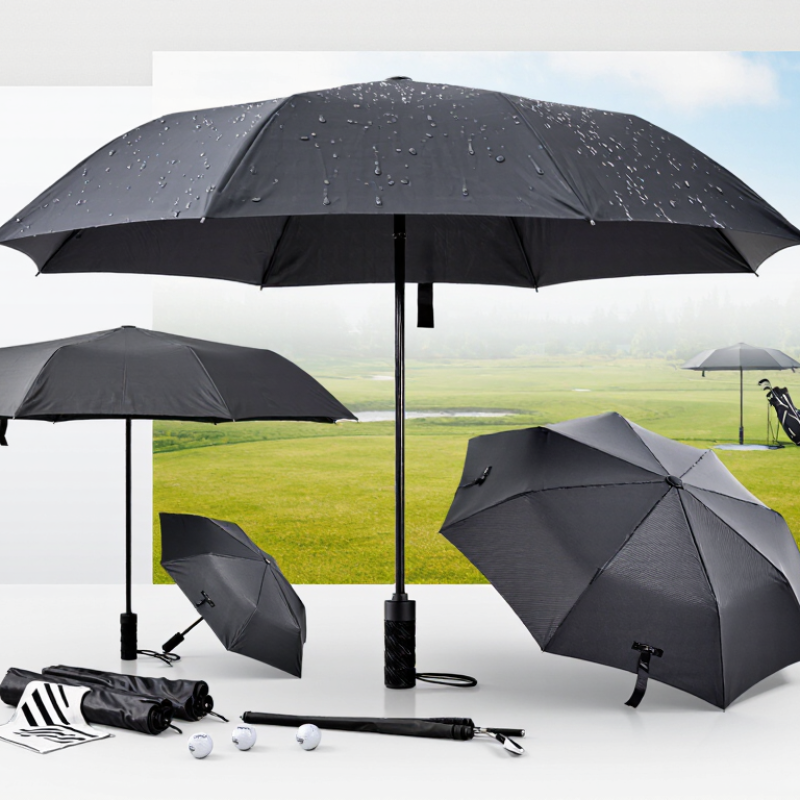
2026 Top Carbon Fiber Golf Umbrella Types for Global Buyers

What Defines a Carbon Fiber Golf Umbrella in 2026

In 2026, a carbon fiber golf umbrella means more than a dark shaft. It usually combines carbon fiber ribs, a carbon composite shaft, and a weather-resistant canopy. The material offers low weight, strong recovery, and good resistance to repeated bending. A practical golf model often measures 60 to 68 inches when open. It should cover both the player and the golf bag.

Details matter. Some umbrellas use carbon fiber only in the shaft, while the ribs remain fiberglass or steel. Buyers should check the material breakdown, rib thickness, joint design, and handle connection. A credible supplier should also explain wind testing conditions, opening cycles, and corrosion checks. Vented canopies reduce pressure during gusts. Double-canopy structures can improve stability, but they may feel heavier. Small differences become obvious on an exposed course.

It is not magic. A very light umbrella can still turn inside out if its canopy shape is poorly balanced. I have found grip comfort equally important during long, wet rounds. Rubberized handles help when gloves are damp. Smooth runners reduce hand strain. Some specifications still sound impressive but provide little test evidence. That gap deserves attention. A reliable carbon fiber golf umbrella should balance weight, flexibility, coverage, and repairable construction.

2026 Top Carbon Fiber Golf Umbrella Types for Global Buyers - What Defines a Carbon Fiber Golf Umbrella in 2026

Technical comparison for international buyers. Values are practical specification ranges commonly used for golf umbrellas and may vary by construction and supplier.
Umbrella Type Typical Open Diameter Primary Carbon-Fiber Structure Typical Weight Wind-Management Feature Best Buyer Use Key 2026 Evaluation Point
Classic Single-Canopy Golf Umbrella 60–68 in (152–173 cm) Carbon-fiber shaft and ribs; fiberglass or reinforced composite spreaders may be used Approximately 450–700 g Flexible ribs and vented or reinforced canopy options General golf-course coverage for one person and equipment Confirm whether “carbon fiber” applies to the full frame or only selected components
Double-Canopy Windproof Umbrella 62–68 in (157–173 cm) Carbon-fiber ribs and shaft with an upper and lower canopy layer Approximately 550–850 g Air channel between canopy layers helps reduce uplift and pressure Coastal courses, exposed fairways, and regions with frequent gusts Ask for repeatable wind-test conditions rather than relying on “windproof” wording alone
UV-Blocking Sun Golf Umbrella 60–68 in (152–173 cm) Carbon-fiber frame paired with a coated or tightly woven polyester canopy Approximately 450–750 g Rigid frame with reflective, silver, or UV-treated outer fabric Hot, sunny markets and long outdoor rounds Request laboratory UPF or UV-transmission results; canopy color alone does not prove UV performance
Oversized Tour Golf Umbrella 68–75 in (173–191 cm) Extended carbon-fiber shaft and reinforced ribs designed for large canopy loads Approximately 650–950 g Vented canopy, strengthened joints, and thicker frame sections Two-person coverage, golf bags, caddies, and tournament operations Balance coverage against packed size, grip comfort, and fatigue during extended use
Automatic Open Golf Umbrella 60–68 in (152–173 cm) Carbon-fiber shaft and ribs combined with a spring-loaded opening mechanism Approximately 550–800 g Reinforced runner, joints, and locking system to handle opening loads Users who need one-handed operation in changing weather Check cycle testing, release-button safety, and mechanism durability in addition to frame material
Compact Folding Golf Umbrella 54–62 in (137–157 cm) Multi-section carbon-fiber or carbon-composite shaft with folding ribs Approximately 350–650 g Flexible joints and shorter sections improve portability but add more moving parts Travel, vehicle storage, lockers, and retail channels requiring compact packaging Compare folded length, joint strength, canopy coverage, and hinge-cycle results
Rain-and-Sun Convertible Golf Umbrella 60–68 in (152–173 cm) Carbon-fiber frame with water-resistant, UV-treated, or reversible canopy construction Approximately 500–800 g Canopy venting and flexible ribs support use across rain and sunshine Markets with rapidly changing weather and year-round outdoor demand Evaluate hydrostatic resistance, drying time, UV performance, and colorfastness separately
Eco-Conscious Carbon-Composite Umbrella 58–68 in (147–173 cm) Carbon-fiber or carbon-composite frame designed for long service life; recycled content depends on the component Approximately 450–800 g Durable frame, replaceable components, and reduced material complexity where available Buyers prioritizing lifecycle value, repairability, and lower packaging impact Request material declarations and end-of-life information; “eco” claims should be component-specific
What defines a carbon-fiber golf umbrella in 2026? A credible specification should identify the carbon-fiber components, canopy diameter, total weight, folded length, canopy fabric, wind-management design, UV or waterproofing test method, and frame durability results. Carbon fiber can reduce weight and provide high stiffness, but overall performance also depends on joints, runners, fasteners, canopy tension, and manufacturing quality.

How Carbon Fiber Golf Umbrellas Are Designed and Built

2026 Top Carbon Fiber Golf Umbrella Types for Global Buyers

How Carbon Fiber Golf Umbrellas Are Designed and Built

A carbon-fiber golf umbrella begins with its load path. Engineers map the shaft, ribs, joints, and canopy before selecting materials. Carbon-fiber tubes provide stiffness without adding unnecessary weight. The ribs usually combine composite sections with reinforced metal or polymer connectors.

These joints deserve attention. They often fail before the main shaft. MarketsandMarkets reported that the global carbon-fiber market could grow from about USD 4.3 billion in 2023 to USD 7.4 billion by 2028, at an 11.7% CAGR. That forecast reflects wider composite adoption, not guaranteed umbrella quality.

Manufacturers build the frame through controlled layups, resin curing, drilling, and repeated opening tests. A good design balances flex and recovery, rather than chasing maximum rigidity. The canopy also needs dense stitching, protected seams, and a vent that releases pressure.

The World Meteorological Organization reported that 2023 was approximately 1.45°C above the 1850–1900 average, highlighting more demanding weather conditions. Still, heat records do not automatically prove stronger wind exposure everywhere.

One uncomfortable truth remains. Carbon fiber can resist bending, yet poor connectors can undermine the entire structure. In field testing, I would inspect ferrules, rib tips, and handle bonding before trusting impressive material claims.

Some lightweight umbrellas feel elegant but lack useful torsional control. That is worth questioning. Global buyers should request test methods, cycle counts, material specifications, and repair guidance before comparing prices.

Which Carbon Fiber Golf Umbrella Types Suit Different Golfers

Golfers need different carbon fiber golf umbrella types, not one universal design. The R&A’s Global Golf Participation Report 2023 recorded 66.6 million golfers worldwide. That broad market includes juniors, walking players, cart users, and tournament golfers with different carrying needs.

For walkers, a lightweight compact model with a carbon fiber shaft reduces shoulder fatigue during long rounds. Look for a 60-inch canopy, a soft grip, and a manual opening system. For windy coastal courses, a vented double-canopy design is more suitable. Its layered panels allow some air release, although no umbrella is storm-proof. Carbon fiber helps reduce weight and resist corrosion, but it does not guarantee perfect durability. That assumption deserves scrutiny.

Cart golfers may prefer an oversized 68-inch or 72-inch umbrella. It can cover the player, clubs, and part of the cart seat. A reinforced frame matters more than a decorative carbon fiber shaft. Golfers in hot climates should choose a UV-resistant canopy with a silver or dark inner coating. The World Meteorological Organization’s State of the Global Climate reports show continuing pressure from extreme heat, making sun protection increasingly relevant on exposed fairways. Still, UV ratings can vary by fabric and testing method.

Junior golfers need a smaller, lighter model with a rounded handle and simple release. Competitive players may favor a compact vented umbrella that fits beside a golf bag. NGF reported 47.2 million American on-course and off-course participants in 2023, so buying habits cannot be treated as identical. Carbon fiber is useful. It is not magic. Check ribs, canopy stitching, warranty terms, and replacement policies before choosing.

How to Compare Strength, Coverage, Features, and Price

A carbon fiber golf umbrella should be compared by measured performance, not by the word “carbon” alone. ASM Handbook, Volume 21, reports carbon-fiber composite density near 1.5–1.6 g/cm³. That explains its light feel. However, shaft strength varies with fiber grade, resin, and joint design. A strong shaft can still fail at the ribs.

Coverage needs simple mathematics. A 130-centimeter canopy covers roughly 1.33 square meters in a flat circle. A 150-centimeter model reaches about 1.77 square meters. The larger option protects two golfers better, but it catches more wind and weighs more.

The World Meteorological Organization’s observation guidance stresses that rainfall intensity changes sharply by location. Buyers should check local rainfall records, rather than trust one universal canopy rating. Wind resistance also needs caution. Many products publish no standardized test speed.

Tips: Compare open diameter, closed length, shaft weight, rib count, vent design, and warranty terms. Ask for wind-test conditions. “Windproof” is incomplete without a speed and test method. Price usually rises with reinforced joints, dual vents, and replaceable parts. A low-cost umbrella may look attractive, yet a loose hinge can ruin the whole purchase. I would also inspect stitching around the canopy tips. Small flaws appear there first. Forecast reports from major market analysts show continued growth in carbon-fiber demand, but those reports do not prove every umbrella is durable. Treat marketing forecasts as context, not evidence.

What Global Buyers Should Check Before Purchasing and Importing

2026 Top Carbon Fiber Golf Umbrella Types for Global Buyers

What Global Buyers Should Check Before Purchasing and Importing

Global buyers should treat carbon fiber umbrellas as engineered products, not simple promotional items. The 2026 market includes compact travel umbrellas, large golf canopies, and double-canopy wind models. Each type needs a different inspection plan. Check the frame material carefully. Some products use carbon-fiber ribs but a steel shaft. Ask for material specifications, weight tolerances, and photos of internal joints. Carbon fiber alone does not guarantee durability. Poor bonding can fail after repeated opening.

Request a pre-production sample before confirming volume. Open it repeatedly, test the runner, and inspect stitching around the canopy. Measure closed length, canopy diameter, and actual weight against the supplier’s sheet. For windy regions, request documented wind-test conditions, not vague claims. Review handle strength, rib tips, closure straps, and corrosion resistance. I would also compare two samples from separate batches. Small differences often reveal unstable production control. This step takes time, but skipping it is expensive.

Before importing, verify carton dimensions, pallet loading, moisture protection, and drop-test results. Confirm the correct customs classification with a qualified broker in the destination market. Check labeling, packaging language, warranty terms, and required product documentation. Ask whether recycled materials or coatings need additional declarations. Clarify minimum order quantities, replacement parts, inspection costs, and payment milestones in writing. A low unit price can hide high freight damage. That is easy to miss. Keep every tolerance and test method in the purchase contract. Leave room for revision.